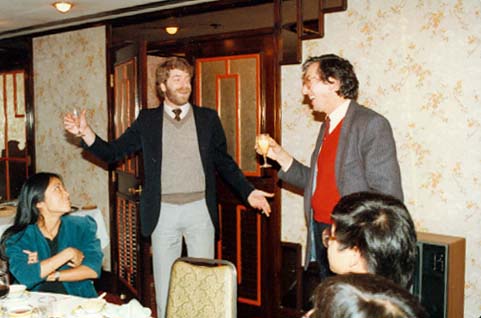
It’s just too hard to imagine the world without Peter Mackler in it. I was 29 years old when I went to work for Peter at AFP’s Asia Desk in Hong Kong 25 years ago. I had journalism experience but wasn’t so strong in French-to-English translations. Peter never let any weakness or excuses get in the way of constructive criticism. “Hammond,” he would shout out across everyone in the news room high up in the New Mercury House, “why did you bury the lead in the second paragraph on the Vietnam story?” We all learned quickly that he didn’t intend to blast us personally; it was just his way of instructing the whole room at once. Every morning he would read through all the dispatches of the previous 24 hours and any story that was less than perfect in his view was noted for us publicly. But he also had a “Kudos” board where he posted stories that he thought were well done. He was the best mentor I ever had.
Peter’s dedication was amazing. His idea of entertaining his young daughters on a Saturday was to bring them to the office, or at least he felt the obligation to check up on things briefly on the weekends and had them tag along. On one of those occasions, little 3-year-old Lauren was following her dad around the office, saw an interesting button at eye-level on the big computer in the back of the office, and single-handedly shut down all the news coming into and out of the Asia desk. Another time, a typhoon made a middle-of-the-night, direct hit on Hong Kong that disrupted everything, including all public transportation. I was due at work the next morning and was two hours later than my assigned time arriving, having had to hitchhike with few private vehicles on the roads. Peter had spent the night in the office, and was the sole person there, busily editing dispatches when I arrived. “Where is everybody? You’re late,” he said, as he handed me a pile to edit.
We had some major stories in those years: the shooting down of the Korean jetliner, the assassination of Indira Gandhi, the abrupt departure of Ferdinand and Imelda Marcos, the settling of terms for Britain’s handover of Hong Kong to China. Those were breaking stories with news coming fast and furious from many bureaus. Peter’s intensity upgraded to a controlled frenzy as he simultaneously directed coverage by the bureaus over the phone and hovered over us as we cobbled the stories together. When we had time, someone would run upstairs to check the Reuter’s wire that happened to be on another floor, so we could see what time they had posted their stories compared to ours. If we had it first, the smile on Peter’s face could light up the room.
My husband, Jim, and I got to know Peter and Catherine socially in Hong Kong, partly due to our both having young children who played together. Over the years, we moved to Brussels and they moved to Paris, and we moved to South Carolina and they moved to Washington, D.C. We stayed in touch, visited back and forth, and vacationed together in a 400-year-old stone farm house in the Dordogne, a semi-tropical beach resort at Kiawah along South Carolina’s coast, and a Blue Ridge mountain retreat in Virginia. Our children, who had competed with Peter to see who could throw rocks the farthest under the Pont du Gard, grew into interesting young adults – a lawyer, a playwright, an artist, a musician. Peter, on those vacations, would combine relaxing with periodic bouts of working on his special, personal projects – helping underpriviledged youth gain life skills through journalism was one for which he was particularly proud.
Peter was a good friend, even from long distances. When my husband had cancer and we traveled to Johns Hopkins University Hospital in Baltimore for his surgery, Peter drove from Washington on a work day to spend the hours with me while Jim was in surgery, and he and Catherine returned again in the days afterward while Jim was recovering. While Peter and I were attempting to ask the hospital receptionist where we could find a cafeteria, she visibly blanched while looking at Peter and stumbled over her words. While I stood there wondering what was wrong, Peter immediately recognized the problem and raced to her rescue saying, “No, I’m not Chuck Norris. I know I look like him, but I’m not him.”
I was privileged to be able to work for Peter and learn from and be inspired by him. I’m honored to have had him as a friend for these many years. Peter is a good guy who has left this world too soon. We will miss him dearly.
-- Elizabeth Hammond
Columbia, South Carolina
USA
(AFP story sign-off - EGH)
Saturday, June 28, 2008
Charles Whelan: A hard-driven professional
I was walking through Safeway supermarket in Bethesda in late March 2002. My wife had just been diagnosed with a serious illness and I was completely at a loss.
My cellphone suddenly rang. It was Peter, calling from Paris."Now this is what you have to do," he said. "First, ring this number in New York. She's a friend and she's the top cancer councellor in the country. After that ...."
Who else but Peter Mackler would respond so quickly and with so much thought and generosity to a colleague's woes. Many people helped me over the next couple of years as Youngju's health failed but I still get a lump in my throat when I think of Peter's voice on the end of that phone call.
I last saw him in Busan, South Korea in winter 2005. He was working at the State Department and had been traveling the world on no food and sleep with with Condy Rice, ending up in Busan for an Asian summit. He looked as tired as can be but still he sat down and hung on in the AFP media centre office for a couple of hours while we finished up the day's file, just so that he could join us for a couple of hours of beers and fellowship.He was a hard-driven professional and loved the cut and thrust of the game. But what distinguished him mostwas his deep well of humanity. The world is a poorer place.
--Charles Whelan
My cellphone suddenly rang. It was Peter, calling from Paris."Now this is what you have to do," he said. "First, ring this number in New York. She's a friend and she's the top cancer councellor in the country. After that ...."
Who else but Peter Mackler would respond so quickly and with so much thought and generosity to a colleague's woes. Many people helped me over the next couple of years as Youngju's health failed but I still get a lump in my throat when I think of Peter's voice on the end of that phone call.
I last saw him in Busan, South Korea in winter 2005. He was working at the State Department and had been traveling the world on no food and sleep with with Condy Rice, ending up in Busan for an Asian summit. He looked as tired as can be but still he sat down and hung on in the AFP media centre office for a couple of hours while we finished up the day's file, just so that he could join us for a couple of hours of beers and fellowship.He was a hard-driven professional and loved the cut and thrust of the game. But what distinguished him mostwas his deep well of humanity. The world is a poorer place.
--Charles Whelan


Rob Woollard: Answer before the question
The only man I've ever met who could give you an answer before you'd even asked the question, I often ended conversations with Peter shaking my head in disbelief, exasperation or admiration -- and quite often a combination of the three. His relentless drive and sheer hunger for news reminded me of why I wanted to be a journalist in the first place.
A whole generation of AFP journalists can thank Peter for helping to build a service which has flourished, allowing many to build rich and varied careers that leave us thinking we are some of the luckiest hacks ever to have picked up a notebook and pen. I know I do.
More than anything else, though, it is his innate decency that I will remember: his having the unfailing habit of always thinking first and foremost of the other person ("Is everything okay? Are you sure? Do you need some time off?"), of living his life to an unwavering set of principles. I never felt that I couldn't talk to him if I had a problem, professional or personal, important or trivial. He would take the time to listen and offer sensible advice as required.Anyone who worked with Peter had disagreements with him from time to time.
For Peter, I suspect, frank exchanges of opinion were a sign of a healthy newsroom -- evidence of the sort of vigorous free-thinking that he encouraged and applauded.I always knew that I could speak openly to him without fear of recrimination, that even if we we disagreed on something, it would be forgotten by the end of the day. That is a very rare, and very human, quality.Hemingway once wrote that the world is a fine place and worth fighting for. Peter made a lot of us feel like that on a daily basis. God bless him.
--Rob Woollard
AFP Los Angeles
A whole generation of AFP journalists can thank Peter for helping to build a service which has flourished, allowing many to build rich and varied careers that leave us thinking we are some of the luckiest hacks ever to have picked up a notebook and pen. I know I do.
More than anything else, though, it is his innate decency that I will remember: his having the unfailing habit of always thinking first and foremost of the other person ("Is everything okay? Are you sure? Do you need some time off?"), of living his life to an unwavering set of principles. I never felt that I couldn't talk to him if I had a problem, professional or personal, important or trivial. He would take the time to listen and offer sensible advice as required.Anyone who worked with Peter had disagreements with him from time to time.
For Peter, I suspect, frank exchanges of opinion were a sign of a healthy newsroom -- evidence of the sort of vigorous free-thinking that he encouraged and applauded.I always knew that I could speak openly to him without fear of recrimination, that even if we we disagreed on something, it would be forgotten by the end of the day. That is a very rare, and very human, quality.Hemingway once wrote that the world is a fine place and worth fighting for. Peter made a lot of us feel like that on a daily basis. God bless him.
--Rob Woollard
AFP Los Angeles
David Millikin: Words fail
This is my third attempt at writing a small remembrance of Peter.
Unlike my more eloquent colleagues, words fail me utterly in trying to describe how important Peter was to me over the 25 years we shared at AFP.
Like so many others, I was one of Peter's hires -- onto the Hong Kong desk in 1983 -- and he remained a trusted mentor and reliable confidant through all the ups and downs of the next two decades, whether we were working in the same bureau or region, or living continents apart.
Others have described perfectly Peter's limitless energy, his wonderful wry humor and his amazing contributions to AFP. For me, more importantly, he was simply the kindest, most trustworthy person I've known and I'm going to miss him terribly.
--David Millikin
Unlike my more eloquent colleagues, words fail me utterly in trying to describe how important Peter was to me over the 25 years we shared at AFP.
Like so many others, I was one of Peter's hires -- onto the Hong Kong desk in 1983 -- and he remained a trusted mentor and reliable confidant through all the ups and downs of the next two decades, whether we were working in the same bureau or region, or living continents apart.
Others have described perfectly Peter's limitless energy, his wonderful wry humor and his amazing contributions to AFP. For me, more importantly, he was simply the kindest, most trustworthy person I've known and I'm going to miss him terribly.
--David Millikin
Phil Chetwynd: Impossibly big-hearted Peter
Over the past two years I usually spoke to Peter every couple of months. The trigger for the conversation was often a banal organisational matter or petty difference between AFP Washington and Hong Kong which could be resolved in a minute, but the talk always roamed wildly over a dizzying array of subjects taking in most of the global issues of the day, often touching on the US elections and always ending around half an hour later with Peter asking about the welfare of your family. He did it every time, and every time I would put the phone down with a broad smile across my face.
Any lingering frustrations were simply blown away by Peter's impossibly big-hearted personality. Typically, one of the last emails he sent to me was to congratulate me on a promotion. The four weeks I spent with Peter in New York in the aftermath of 9/11 were a revelation. I had never seen anybody organise, inspire and drive a team to such heights. He was often totally unreasonable, but he was always brilliant. Story ideas simply flowed out of him, and when his well of inspiration ran dry he managed to coax new ideas out of you which he promptly wrote up on the infamous whiteboard he loved to use for coverage. The results were stunning -- without a doubt he inspired, cajoled or pushed us to produce immeasurably better work. And when it all became too much he was always on hand with a kind word, a suggestion of a day off or an anecdote. Once again, the frustrations melted away and you were left smiling.
I remember one day I had been reporting around Ground Zero and had jumped into a taxi driven by a newly-arrived Indian immigrant hoping to quickly return to the office to file. As I worked on my notes I paid no attention to where we were going and I soon realised were going the wrong way across the Brooklyn Bridge. With a security alert in place on the other side, I was blocked for hours unable to file my story and gripped by mounting panic as I imagined Peter's growing anger. When I finally ran into the office on the edge of tears and told my account Peter roared with laughter. "I love it, a typical New York story." He then immediately took me out to his favourite sandwich bar to show me another side of his beloved city.Peter's death has deprived us of a wonderful human being. We will not forget him.
-- Phil Chetwynd
AFP Asia Editor
Any lingering frustrations were simply blown away by Peter's impossibly big-hearted personality. Typically, one of the last emails he sent to me was to congratulate me on a promotion. The four weeks I spent with Peter in New York in the aftermath of 9/11 were a revelation. I had never seen anybody organise, inspire and drive a team to such heights. He was often totally unreasonable, but he was always brilliant. Story ideas simply flowed out of him, and when his well of inspiration ran dry he managed to coax new ideas out of you which he promptly wrote up on the infamous whiteboard he loved to use for coverage. The results were stunning -- without a doubt he inspired, cajoled or pushed us to produce immeasurably better work. And when it all became too much he was always on hand with a kind word, a suggestion of a day off or an anecdote. Once again, the frustrations melted away and you were left smiling.
I remember one day I had been reporting around Ground Zero and had jumped into a taxi driven by a newly-arrived Indian immigrant hoping to quickly return to the office to file. As I worked on my notes I paid no attention to where we were going and I soon realised were going the wrong way across the Brooklyn Bridge. With a security alert in place on the other side, I was blocked for hours unable to file my story and gripped by mounting panic as I imagined Peter's growing anger. When I finally ran into the office on the edge of tears and told my account Peter roared with laughter. "I love it, a typical New York story." He then immediately took me out to his favourite sandwich bar to show me another side of his beloved city.Peter's death has deprived us of a wonderful human being. We will not forget him.
-- Phil Chetwynd
AFP Asia Editor
Jean-Louis Doublet: We never made it to Nathan's on Coney Island
Peter as a jounalist was top-notch but it's his qualities as a man that I am going to miss most.
His quest always to get the most accurate information on the wires as fast possible was sometimes exhausting but as so many here have said, he was pretty much always right in his calls. He had a wonderful sense of self-deprecation and always enjoyed to tell the story about when he called Joan of Arc "the little flea" in the copy. As a young journalist with the English desk in Paris, he had to translate the French word "pucelle" and rather than looking in the dictionnary, he went for what seemed to him the most obvious.
It is may be the only story he ever wrote that had to be corrected and he from then on used it as a "never assume anything" example to his colleagues. I am thinking today of our colleague Graham Brown, to whom he showed tremendous support and love in time of illness. So Long Peter, sorry we'll never make it to Nathan's in Coney Island.
--Jean-Louis Doublet
AFP Paris
His quest always to get the most accurate information on the wires as fast possible was sometimes exhausting but as so many here have said, he was pretty much always right in his calls. He had a wonderful sense of self-deprecation and always enjoyed to tell the story about when he called Joan of Arc "the little flea" in the copy. As a young journalist with the English desk in Paris, he had to translate the French word "pucelle" and rather than looking in the dictionnary, he went for what seemed to him the most obvious.
It is may be the only story he ever wrote that had to be corrected and he from then on used it as a "never assume anything" example to his colleagues. I am thinking today of our colleague Graham Brown, to whom he showed tremendous support and love in time of illness. So Long Peter, sorry we'll never make it to Nathan's in Coney Island.
--Jean-Louis Doublet
AFP Paris
Subscribe to:
Posts (Atom)


.JPG)