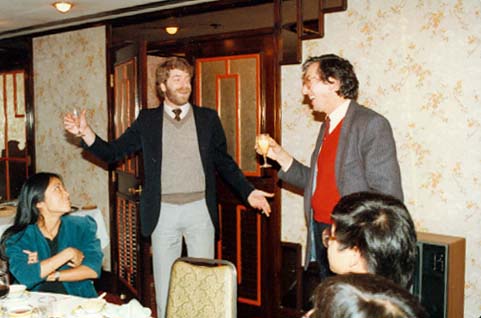
Everything I know about news, most of what I know about raising fierce and spirited daughters, and much of what I know about leaving the world a better place and never abandoning the quest to make this universe kinder--I learned it from Peter.
And he was kind and generous enough to make me feel like the most valued and talented reporter on Earth. He used to call me the Energizer Bunny, because I loved the news so much and never wanted to stop once I had a good story. He teased me for years about the day I suffered a fractured nose and concussion at a news conference and filed two stories before I fled to the ER. But really, how could anyone miss a deadline on Peter's watch?
I would have walked to the moon for him any day, and twice on Sundays. I pray I never let him down. Even now, eight years after I left AFP, I find myself thinking about three times a week, 'What would Peter do?'
Among so many other things, he taught me that after a major disaster, insurance councils are the bodies that estimate damages; that every time you report something from the legislative branch of government, you have to get a comment from the executive branch; that just because a situation is confusing, a news story doesn’t have to be; that if you’re ever stuck on a lead, go for the sentence that predicts the future, because information is that which reduces uncertainty; that changing the world in tiny steps is not only possible but essential, and you simply have to find a place to start; that the same qualities that make children challenging at a young age make them brilliant, independent, and beautiful and even more loved when they are older; that a husband should always take a call from his wife and answer it sweetly no matter what else is happening; that maturity and true kindness mean supporting and loving people the most when they deserve it the least; and that no one in the family should ever give mommy an exercise video for mother’s day unless she has explicitly requested it, and even then it should come with a note that says, ‘You don’t need this, but…’
I also never knew anyone so proud of his gifted and brilliant wife, and equally gifted and brilliant daughters.
A friend's grandmother used to say of her late husband, 'Now THAT was a husband.' Of Peter Mackler, mensch and mentor extraordinaire, we can say, 'Now THAT was a reporter, an editor, a father, a husband, and a teacher' of the first order.
The world has lost one of its brightest lights, and nothing, nothing, will ever be the same.
-- Sarah Jackson-Han
jacksonhans@rfa.org
Sunday, June 22, 2008
Jitendra Joshi & Steve Collinson: One last big story
“What are you working on?” Peter would exclaim, bouncing out of his office during this year’s endless White House campaign, as our eyelids grew heavy and inspiration ran dry. Even at 3:00 a.m. on a primary night, into his 20th hour at work, he would still be crackling with story ideas and suggestions for the angle we should be writing.
The word indefatigable barely describes Peter’s nuclear-fuelled energy and his ardour to beat the competition, whatever the odds. But however exhausting those nights were, there was a special electricity in the air from covering one of the world’s biggest stories under the guidance of this one-man dynamo of motivation, enthusiasm and creativity.
He was the consummate reporter, who would rattle flawless intros off the top of his head, and had a batting average superior to any of his beloved
He would revive flagging campaign reporters with only slightly embellished tales of his days on the trail with Ronald Reagan, and was fascinated with the implications of this historic election cycle. Though he gave himself no quarter, he was the first to tell tired staffers to take time off.
The 2008 campaign turned out to be Peter’s last big story. It’s only just sinking in that he won’t be there to lead us through the conventions, or through the presidential debates, or on election night itself in November. The electricity generated by this dramatic turning point in history will still be there. But with the passing of our friend and boss, a vital current will be missing.
-- Jitendra Joshi and Steve Collinson


Saturday, June 21, 2008
Jay Branegan: Mackler saw journalism as a vehicle to teach life skills
Peter created the curriculum for something close to his heart that he called "Project Plato." It was an introductory course in journalism for high school students. But Peter envisioned it as teaching "life skills" to kids, particularly underprivileged kids in Washington, DC. He felt that even if you're not going to become a journalist, you need to be able to write clearly, to read critically, to know how to do research, to know how to formulate questions, talk to strangers and people of influence, how to organize material, how to assess the information you have.
He sold this idea to a very well-known magnet school in Georgetown, the Duke Ellington School of the Arts. Peter, while holding down a fulltime job, taught this course two days a week to high schoolers in the school's writing program, with the mission of putting out an online magazine. And the kids were expected to report real stories in the real world (this was right after 9/11, so they did stuff related to that, issues about race and young people (historically black colleges), etc.) This notion that the kids could do stories they were really interested in raised the kids' enthusiasm to a whole new level. Peter was great with the students -- watching him in that classroom raised enormously my already-high respect for him.
But Peter had big plans for Project Plato--he constructed as a kind of module, that could be taught anywhere, and delivered as a package. And he thought it would be very valuable in developing countries. He had discussions with folks from the World Bank who were interested in using it for an education program in Africa. Plato, at least at Duke Ellington, didn't surive his transfer back to France, but I think he still had it in the back of his mind. In my mind, Plato was the progenitor for GMF -- teaching journalism in an international forum. And I suspect he probably hoped to use GMF to find some new homes for Plato.
He developed and taught the high school journalism course, Project Plato, for underprivilged students in Washington, based on the premise that reporting and writing can teach important life skills to young people.
-- Jay Branegan
He sold this idea to a very well-known magnet school in Georgetown, the Duke Ellington School of the Arts. Peter, while holding down a fulltime job, taught this course two days a week to high schoolers in the school's writing program, with the mission of putting out an online magazine. And the kids were expected to report real stories in the real world (this was right after 9/11, so they did stuff related to that, issues about race and young people (historically black colleges), etc.) This notion that the kids could do stories they were really interested in raised the kids' enthusiasm to a whole new level. Peter was great with the students -- watching him in that classroom raised enormously my already-high respect for him.
But Peter had big plans for Project Plato--he constructed as a kind of module, that could be taught anywhere, and delivered as a package. And he thought it would be very valuable in developing countries. He had discussions with folks from the World Bank who were interested in using it for an education program in Africa. Plato, at least at Duke Ellington, didn't surive his transfer back to France, but I think he still had it in the back of his mind. In my mind, Plato was the progenitor for GMF -- teaching journalism in an international forum. And I suspect he probably hoped to use GMF to find some new homes for Plato.
He developed and taught the high school journalism course, Project Plato, for underprivilged students in Washington, based on the premise that reporting and writing can teach important life skills to young people.
-- Jay Branegan
Subscribe to:
Posts (Atom)


.JPG)